

A Picture of Israel 2026


Israel’s Society and Economy in Figures 2026 is here!
The Taub Center has published this year’s A Picture of the Nation 2026.
The booklet includes key findings that, among other things, relate to the economic and social costs borne by Israel as the country enters its third consecutive year of war.
The booklet addresses topics from across the Taub Center’s research fields: economics, the labor market, artificial intelligence, demography, welfare, health, environment and health, education, and early childhood.
Here are selected findings from the booklet. To read the full publication click here.
The booklet was written and edited by Prof. Avi Weiss, President of the Taub Center and Professor of Economics at Bar-Ilan University.
The 2026 Iran War
This chapter presents data on several aspects of the operation, including hospitalizations, the number of sirens activated daily, and the number of evacuees, comparing them with the previous round of fighting with Iran and the October 7 War.
The overall number of hospitalizations was greatest during the latest war with Iran – Operation Roaring Lion
In the course of Operation Roaring Lion in March 2026, 7,000 wounded were hospitalized – almost double the number hospitalized during Operation Rising Lion in June 2025 (3,700). Nevertheless, when we look at the daily average, the number of hospitalizations during the 12 days of fighting of Operation Rising Lion was higher.
Although these were mass-casualty events of unprecedented scale in Israel, the healthcare system demonstrated resilience and a commendable level of functioning.

In Operation Roaring Lion there were an average of 2,000 air raid sirens a day
During Operation Roaring Lion, approximately 97,000 sirens were heard in Israel due to rocket fire from Iran, Lebanon, and Yemen. In the first two days of the operation, more than 20,000 sirens sounded. Thereafter the number fell to an average of about 2,000 sirens per day. In the final week before the ceasefire (which came into effect on April 8, 2026) the daily average of sirens fell to about 1,500. From the ceasefire with Iran until June 6, 2026, all sirens were caused by fire from Lebanon — roughly 40 sirens per day on average. In the 24 hours of the June 2026 confrontation with Iran, 2,250 sirens were heard in Israel.
Sirens are activated according to Israel’s geographic division into warning areas. A siren activated in the West Jerusalem area affects about 150,000 residents, whereas a siren activated in Sde Boker affects only a few hundred people.

Macro-Economic Trends
A massive increase in defense expenditures, although not in civilian spending
Civilian expenditures rise sharply toward the end of each year, apparently reflecting an effort to fully utilize the annual budget. After adjusting for inflation, the trend points to overall stability, despite the increase in civilian needs associated with the war. Defense spending, however, tells a different story: since the outbreak of the war, monthly defense expenditures have risen from approximately NIS 7–8 billion to around NIS 14–15 billion. The launch of the second military campaign against Iran has already necessitated an increase in the 2026 defense budget from roughly NIS 120 billion to about NIS 160 billion.

Artificial Intelligence
About one-third of Claude use: programming, education, writing, and content editing:
The graph shows the distribution of selected uses of Claude in Israel at the beginning of 2026. Nearly one-quarter of the use of this tool is for programming and writing code, and about one-sixth is for creating or editing content, whether written or visual, and for education and training purposes. About 1.4% of use is for employment assistance, such as career guidance or writing resumes. About half of uses were not classified.
According to data from Anthropic, Israel ranks second in the world in Claude use per capita. The main uses in Israel are similar to the global average. However, there are some areas in which Israeli users stand out, such as translation, medical consultation, and the creation of religious or spiritual content. Although these uses account for a small share of total use in Israel, they are still notable in international comparison.

Demography
More Israelis are leaving the country, and fewer are returning
Migration to and from Israel has always been the least stable of the three components driving demographic change, and in recent years this component has become even less stable.
Emigration among native-born Israelis, both Jews and non-Jews, has been on a steady upward trend since 2022. Over the past three years, emigration rates have risen far above any level recorded in the preceding decade. At the same time, the number of returning residents who were born in Israel was low compared with the previous decade. Compared with the average for 2014–2022, there was also a dramatic increase in emigration among Jews and non-Jews born in other countries. Finally, despite rising antisemitism, the number of immigrants in 2025 — which rose sharply in 2022 and 2023 following the Russia-Ukraine war — was the lowest since 2014, except for 2020, when strict movement restrictions were imposed due to the COVID pandemic.
The crude emigration rate among the non-Jewish population, most of whom were born abroad, is particularly high: in 2023, it stood at 391 emigrants per 10,000 residents, compared with 16 in the Arab population and 48 in the Jewish population. The combination of trends in immigration and emigration has left Israel with a negative migration balance for two consecutive years.

Welfare
The shortage of social workers and the burden placed on them increase with the poverty level in the locality
Currently, about 18% of social worker positions in local authorities are unfilled, amounting to a shortage of 1,328 professionals. The share of unfilled positions has fluctuated considerably over the years, but the overall trend points to a steadily growing shortage.
The difficulty in filling positions is more severe in localities where social distress is greatest: the share of unfilled positions in local authorities with high poverty rates — where more than 25% of families have income below the poverty line — is much higher than in localities with low poverty rates, where up to 15% of families are below the poverty line. By sector, in Jewish localities, excluding Haredi localities, the average share of unfilled positions stood at about 17% in April 2026, while in Arab localities, and particularly Bedouin localities, it was much higher, at 21% and 26%, respectively.
The number of service recipients per social worker is also higher in the poorest localities than in localities with medium and low poverty levels. This has a decisive effect both on the level of care that can be provided to service recipients and on the burnout of professionals.

Midlife and Single
People aged 50–64 who live alone are poorer than their peers who do not live alone
Among individuals in midlife — and also at older ages — the share of households with income below the poverty line is higher among those living alone than among those who do not live alone. Additional data show that about 16% of the income of people aged 50–65 who live alone comes from benefit payments, compared with about 6% among those who do not live alone. They are also less likely to live in a home they own: about 59% among individuals, compared with 83% among those who are not single. Their social and emotional situation is also worse, and they experience loneliness at four times the rate of those who do not live alone.

Health
An increase in the number of physicians who studied medicine in Israel
The number of new licenses to practice medicine continues to rise, including licenses granted to graduates who studied medicine in Israel. In 2023, their number stood at 750, compared with 672 in 2022.
In recent years, the number of students beginning medical studies at universities in Israel has gradually increased, from 731 new students in 2018 to about 1,400 in 2025. The Ministry of Health aims to reach 1,700 new students in 2030.
This increase is the result of several processes implemented in Israel in recent years, including expanding the number of students in medical schools in Israel and converting training programs intended for foreign students into programs for Israeli students.

The measles outbreak in Israel: a troubling warning bell
The measles outbreak that began in April 2025 is continuing to intensify. The number of cases in Israel per 100,000 population is 55 times higher than in the US and 19 times higher than in Europe. The case fatality rate is almost 4 times higher than in the US and nearly 5 times higher than in Europe.
The reported data in Israel - about 3,600 cases as of the beginning of June 2026 - are most likely only the tip of the iceberg. Statistical models estimate that morbidity is actually 3 to 4 times higher, with the true number of cases between 10,000 and 14,000. The gap between the number of reported cases and the actual number stems from underreporting in isolated communities and from cases that do not reach formal diagnosis.
Although Israel’s vaccination rate is slightly higher than that in the US and Europe - 95%, compared with about 93% and 94%, respectively - the average rate in the large Haredi towns - Jerusalem, Beit Shemesh, Bnei Brak, Beitar Illit, Nof HaGalil, and Safed - is only 84%.

Enviroment and Health
Most environmental expenditure is directed toward waste management
Government expenditures on environmental protection include spending on waste treatment, nature conservation, including biodiversity preservation, reducing air and water pollution, and mitigating climate change and its effects.
In 2024, public expenditure on environmental protection in Israel totaled about NIS 11 billion, in 2024 prices, with local authorities financing 87% of this amount. Most of the expenditure is directed toward waste management, and local authorities finance 92% of this component. In 2024, waste treatment accounted for 83% of total government expenditure on environmental protection, while wastewater treatment accounted for 8.4%. Expenditure on air pollution prevention is especially low, despite the high mortality rates in Israel attributed to this factor.
Looking over time, in 2024, expenditure on waste treatment was 54% higher than in 2013, although the population grew by only 25% over the same period. Most of the increase occurred in the past three years, 2022–2024.

Education
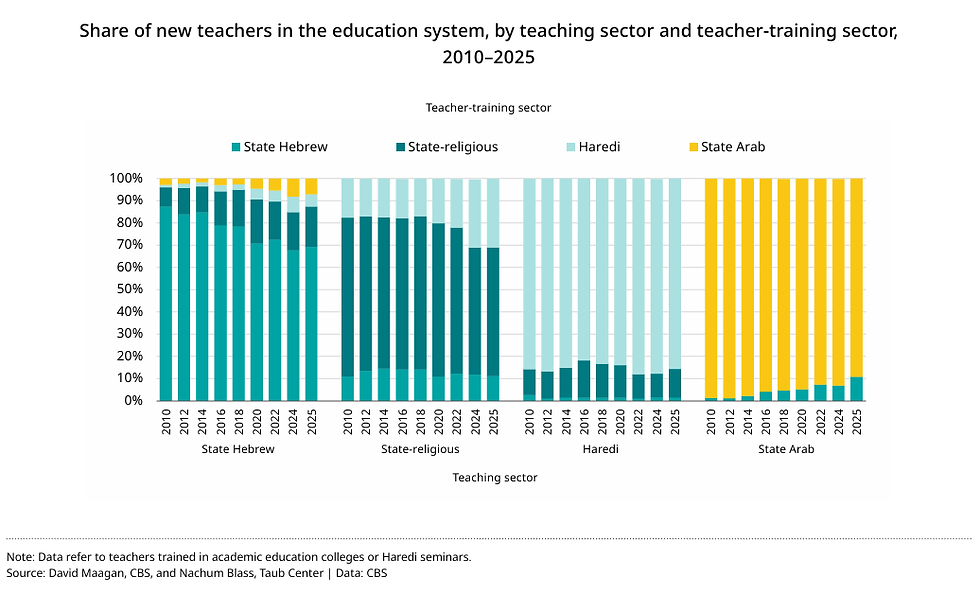
One explanation for the absence of a teacher shortage: the recruitment of boundary-crossing teachers
One explanation for the large gap between the projected demand for teachers and the actual number is the sharp increase in the number of “boundary-crossing” teachers in State Hebrew and State-religious education. In State Hebrew education, about 30% of teachers are Arab or graduates of State-religious or Haredi teacher training institutions, while in State-religious education, about 30% of teachers received their training in Haredi seminaries. Overall, this amounts to tens of thousands of teachers working in schools whose orientation differs from that of the institutions in which they were trained.
The data show that employing boundary-crossing teachers has no substantial effect on student achievements, and they can therefore serve as a possible solution to teacher shortages. In addition, integrating them into school teaching staffs may also have an important social dimension: promoting multiculturalism and fostering tolerance and coexistence in the education system.
Early Childhood
School readiness is lower among children whose parents served in the reserves
In a survey conducted by researchers from the Taub Center Initiative on Early Childhood Development and Inequality among parents of young children, participants were asked the extent to which their child was able to perform basic reading and arithmetic tasks upon entering school. Responses were given on a scale reflecting the child’s level of ability: not at all, to a small extent, to a moderate extent, or to a very great extent. These items were combined into an overall school readiness index, reflecting preschool cognitive skills.
The results show that children aged 4–6 with a parent called for reserve duty at the beginning of the October 7 War demonstrated lower school readiness than children with a parent who was not called up. This finding remained even after controlling for a wide range of demographic and family variables, including the child’s age and gender, family income level, parents’ education, family size, family status, and the emotional availability of the parent who remained at home.
Based on the survey results, it appears that a parent’s prolonged absence from home during national emergencies may disrupt young children’s ability to develop the cognitive, social, and emotional skills needed for the transition to school. This is a critical developmental stage, and harm at this stage may have long-term consequences.

Prof. Avi Weiss, President of the Taub Center and author of the booklet:
“As every year, A Picture of the Nation addresses the major issues facing Israel’s leadership and public. This year, the booklet highlights critical issues such as the growing burden of public debt and defense expenditures, alongside troubling changes in the demographic structure and urgent challenges in health, welfare, and education. The data presented in the booklet can help decision makers formulate informed and beneficial policy that takes into account both ongoing needs and the needs of the hour.”


Comments